Rendering and configuration qualification
This follow-up expands the shadow-crash coverage from PR #7. The supplied crash photo shows Hyprland's crash reporter but contains no backtrace; it cannot establish the cause of that person's crash.
Supported scopes
The ordinary build targets Hyprland 0.56.x and 0.57.0/OpenGL. The experimental Vulkan build targets upstream Vulkan WIP #13272 at b60bb19e8c8f5005a121714520acf41bd095e74b, with the isolated runtime repairs in the preparation recipe. Releases 0.56.x and 0.57.0 have no Vulkan renderer implementation. Removing Hyprflow's OpenGL guard alone would not provide Vulkan rendering.
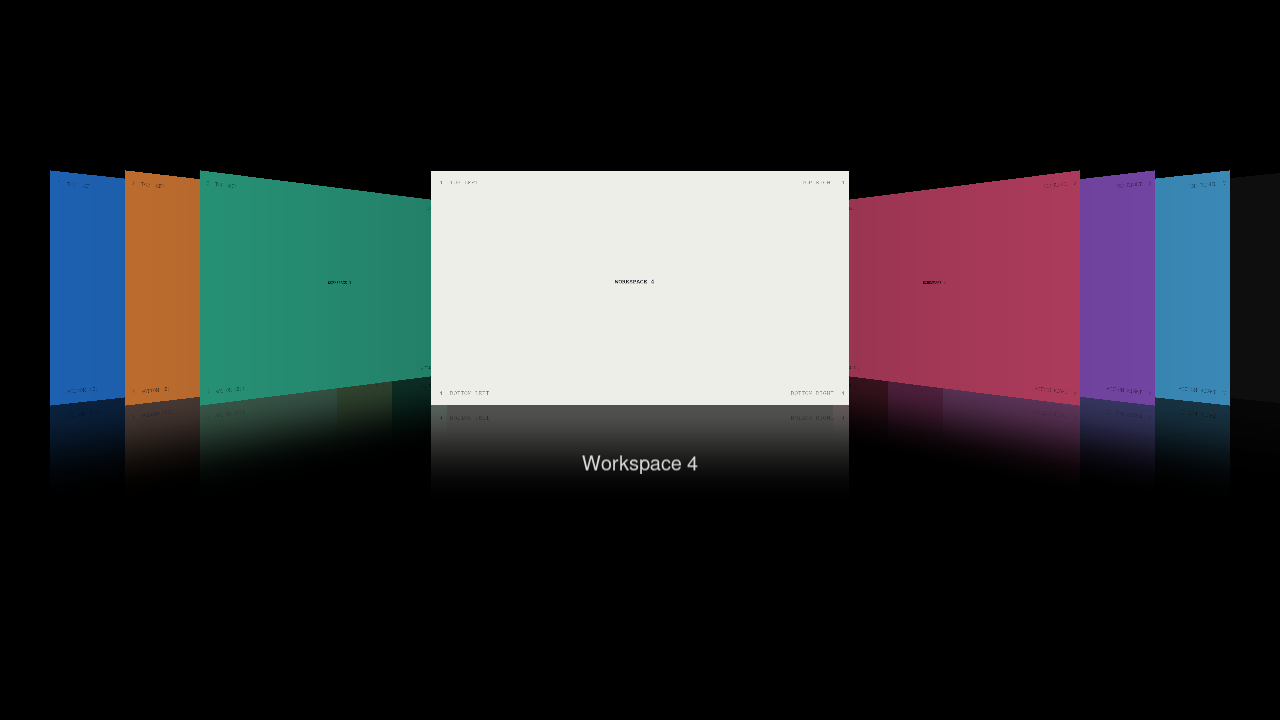
The Vulkan build uses real Vulkan pipelines and captured workspace textures. It draws the perspective cards, reflections, labels, borders, desktop overlay, and blur on an AMD Radeon RX Vega through RADV. Its qualified profile is SDR, normal output orientation. Fractional scaling is tested separately within that profile. Vulkan objects and libraries use a separate build directory.
The machine-readable receipts identify plugin artifacts, effective output state, and passing checks. Render evidence comes from owned compositors and actual GPU readback, not reference-image playback.
Passing receipts
Measured October 26, 2026, on the attached AMD Radeon RX Vega. Both libraries passed build, geometry tests, formatting, and Cppcheck. The website/docs build, local links, and 27 web-script tests also pass.
| Proof | OpenGL 0.56.2 | Patched Vulkan SDK |
|---|---|---|
| Output/color/lifecycle matrix | 25 full-profile checks | 17 SDR/unrotated checks |
| Appearance and invalid/reload settings | 28 checks | 28 checks |
| Release-selection chords | 12 checks | 12 checks |
| Raw-client input/focus | 3 checks | 3 checks |
| Transition/lifecycle | 20 checks, Hyprexpo also loaded | 20 checks |
| Core + synchronization validation | Not a Vulkan target | Zero errors, including graceful shutdown |
Vulkan graphics receipts identify the 1e1 native build. The later 02e and 6a4e builds change only the keybind and focus-cache conditions, respectively; headers, layouts, and graphics remain unchanged. Each scope records its actual native hash. The final SDK has a qualification-specific API suffix so an unpatched prototype with the same upstream commit cannot pass the module's header guard.
Coverage and boundaries
- The OpenGL matrix exercises scale 1/1.25/1.5/2, all three rotations, mirroring, fractional portrait output, and scale/rotation changes while open. It compares accepted/canceled desktop pixels with native references.
- It exercises wide color, negotiated 10-bit buffers, HDR rejection/fallback, and a forced HDR image-description pipeline. The latter is a virtual pipeline stress test, not proof of physical HDR scanout or HDR color accuracy.
- Both matrix profiles exercise cross-monitor workspace rejection, removal of the active virtual output, and ten plugin unload/reload cycles. Additional outputs are headless, so they create no extra host windows.
- Appearance checks cover proportions, spacing, gradient borders, opacity, desktop blur, reflections, labels, invalid values, last-valid behavior, and file/runtime reloads. Raw-client and chord tests check input isolation, focus/submap restoration, and release selection.
- A Hyprland 0.56.1 negative control verifies repeated ABI rejection and a usable compositor afterward. This exposed an unused Aquamarine dependency collision: loading a newer unused library could crash the older compositor even after the header guard rejected the plugin. Linking with
--as-neededremoves that dependency. A minimal rejecting plugin reproduced the original failure.
A historical native-only Vulkan WIP fails a rotated-output control before Hyprflow loads: client content is clipped/sideways and an ordinary native fullscreen roundtrip changes a stale rounded-edge region. The full matrix keeps its pixel assertions; --profile vulkan-sdr explicitly excludes that unsupported native configuration. The module rejects rotated outputs and closes before drawing if an output transform changes while open. Vulkan HDR/FP16, ICC, hardware cursors, explicit client sync, physical multi-monitor scanout, and physical HDR accuracy are not qualified. The native Vulkan shadow wrapper also lacks the window-cutout data available in the modern OpenGL path. Vulkan backdrop blur uses a dense bilinear-paired Gaussian kernel; pixel/performance identity with OpenGL's prefiltered separable blur is not claimed.
Exploratory NVIDIA/Wayland runs exposed parent-window configure and notification races in the harness. These attempts are not counted as a complete current-build NVIDIA qualification. Automated qualification uses the isolated AMD headless path.
Reproduce the proofs
Run from an isolated Hyprflow checkout. Build before loading the library and record its hash. Never replace or rebuild a mapped library.
make check format-check
artifact="$PWD/build/hyprflow.so"
artifact_sha=$(sha256sum "$artifact" | cut -d' ' -f1)
For interactive runs, nested-session.py start opens silently on host workspace 16, unpinned and without taking focus. place and stop keep that confinement. The window is launched with the render_unfocused rule, so the parent keeps sending frame callbacks at misc:render_unfocused_fps while it stays hidden. Without that rule, a hidden Wayland window stops receiving frame callbacks. For background runs, use a headless-capable allocator; the AMD test runtime's preparation recipe includes the explicit render-node selection and strict headless setup. Do not create extra Wayland outputs after the launch rule expires; the matrix uses headless outputs for its second monitor.
Once the owned session has seven calibration fixtures and the exact plugin loaded:
python3 scripts/verify-render-matrix.py "$session_dir" /tmp/hyprflow-proof/matrix \
    --artifact "$artifact" --sha256 "$artifact_sha"
python3 scripts/verify-appearance.py "$session_dir" /tmp/hyprflow-proof/appearance \
    --artifact "$artifact" --sha256 "$artifact_sha"
python3 scripts/verify-select-on-release.py "$session_dir" --artifact "$artifact"
python3 scripts/verify-input.py "$session_dir" /tmp/hyprflow-proof/input
python3 scripts/verify-lifecycle.py "$session_dir" /tmp/hyprflow-proof/lifecycle \
    --artifact "$artifact" --sha256 "$artifact_sha"
The appearance proof replaces fixtures for its detailed blur checks. Restore calibration fixtures before repeating color/geometry measurements. For the experimental Vulkan library, use the matching runtime from the recipe and add --profile vulkan-sdr to the matrix command. A matching Vulkan build deliberately rejects an OpenGL renderer; the ordinary build deliberately rejects Vulkan.
For an explicitly owned older compositor with no Hyprflow loaded:
python3 scripts/verify-plugin-rejection.py "$older_session_dir" "$artifact" \
    --sha256 "$artifact_sha"
Do not judge rejection by the CLI exit code: Hyprland may return zero with a load error. This proof checks the expected reason, unchanged registry, process lifetime, subsequent IPC, and artifact identity across three attempts.
Export selected successful receipts without host paths, process addresses, or raw logs:
python3 scripts/summarize-qualification.py \
    opengl-matrix=/tmp/hyprflow-proof/matrix/manifest.json \
    opengl-appearance=/tmp/hyprflow-proof/appearance/manifest.json \
    --output /tmp/hyprflow-proof/summary.json
The exporter rejects failed receipts, incomplete input restoration, forced flow cleanup, changed screenshot hashes, and private session paths in the export. The raw-input/lifecycle probes retain one virtual keyboard through animations and focus restoration, matching a continuously connected physical keyboard. Keyboard hot-unplug recovery is a separate unqualified case.
Keep failed attempts and native controls alongside the local evidence; do not turn a failed vector into a passing support claim. Stop every owned session when finished. The daily compositor's configuration, plugin list, and renderer are outside these tests.